



Amazon SEO Guide: How Amazon Search Visibility Really Works
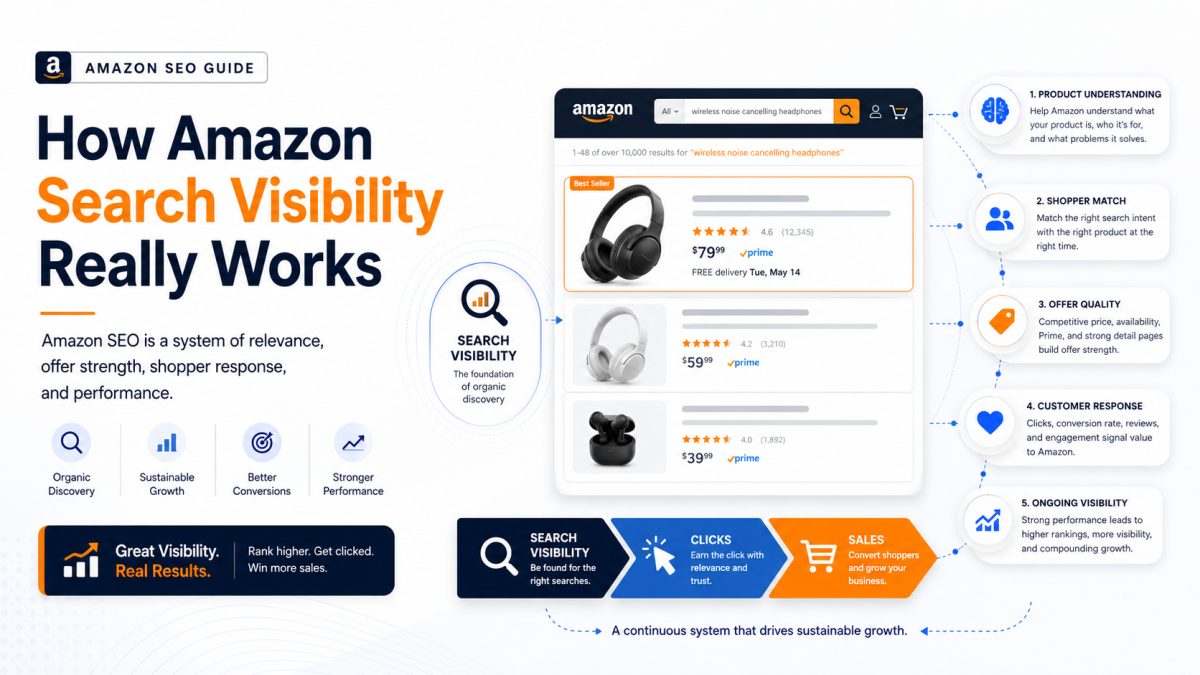
Amazon SEO is not a single edit, a quick title rewrite, or a list of phrases added to a page. It is the process of helping Amazon understand a product, match it with the right shopper, and keep showing it when the offer performs well.
This guide explains the full visibility system without replacing the deeper work covered in separate guides on indexing, catalog structure, variations, suppression, and tracking.
The goal is not to change everything at once. The goal is to find the point where visibility is breaking, fix the biggest blocker first, and measure whether the change helps. That is the foundation of effective Amazon search engine optimization.
What Does Amazon SEO Actually Mean for Sellers?
Amazon SEO is the work of improving how clearly a product is understood, matched, displayed, and evaluated inside the marketplace. It connects product data, shopper demand, offer quality, and performance.
A seller should think of it as a system rather than a one-time task.
Amazon SEO optimizes product listings to improve search result rankings.
Over 61% of U.S. shoppers start product searches on Amazon. Over 60% of U.S. shoppers start product searches on Amazon. 52% of consumers start their product searches on Amazon. Over 61% of U.S. shoppers start searches on Amazon.
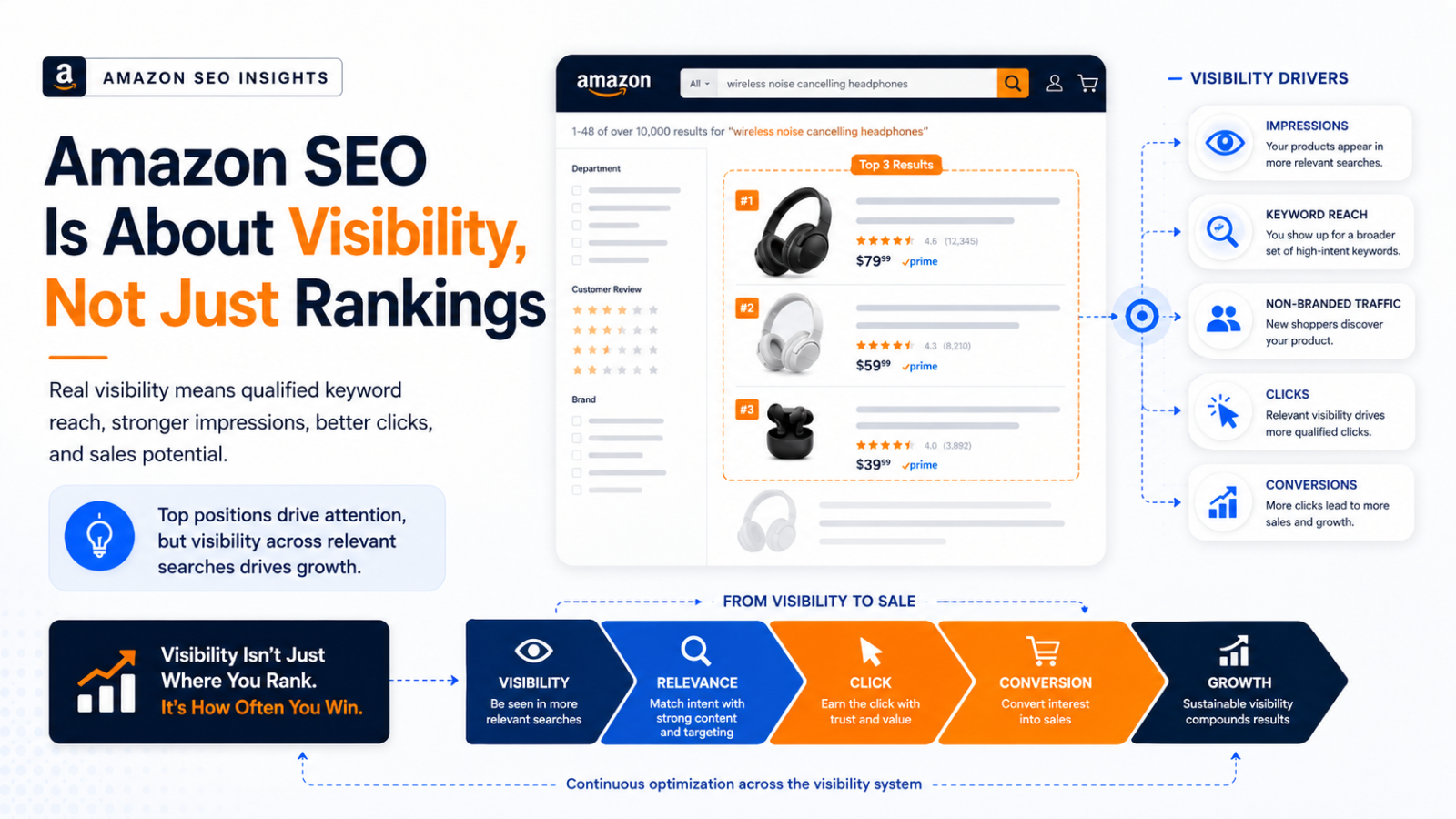
Amazon SEO Is About Visibility, Not Just Search Results
A strong position in the search results for one phrase can look impressive, but it does not always mean the product has broad or useful visibility.
Real visibility means appearing across a useful range of relevant keywords, reaching potential customers, and earning clicks from search results that can lead to sales.
Do not judge success from one screenshot or one tracked phrase. Look at whether the product appears in more qualified search results, whether non-branded traffic is growing, and whether that traffic is useful.
Organic ranking matters, but it is only one part of the full visibility picture.
Over 60% of clicks go to the top three organic search results. 80% of purchased products come from the top 10 search results. 80% of purchases come from the top 10 search results. Shoppers rarely look past the first page of Amazon search results.
High-ranking products gain significant visibility on Amazon. High visibility leads to more impressions and potential customers.
Visibility is broader than rank
Why Amazon’s Product Search Algorithm Works Differently From Google SEO
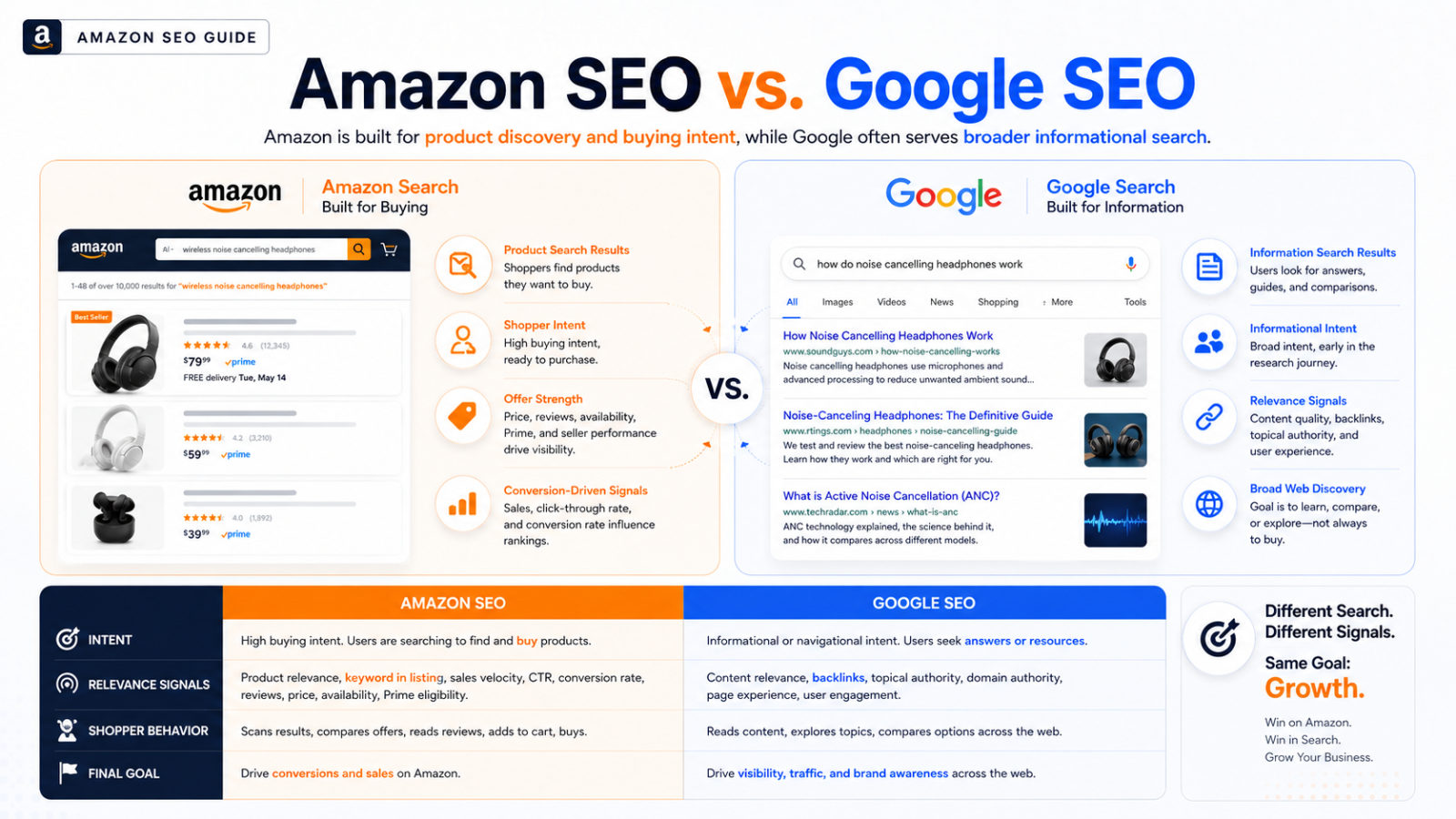
Google and other search engines often help users find information. Amazon’s product search algorithm is built around product discovery, shopper intent, and buying activity.
It must decide not only whether a product page is relevant, but also whether the product and offer are likely to satisfy the shopper.
That difference should shape your decisions. Do not copy a general website SEO process and expect the same result from Amazon’s product search algorithm.
Product relevance, shopper response, availability, offer strength, and sales performance all work together inside the system.
Amazon SEO focuses on transactional intent for product sales. Google SEO targets broad informational searches across the web. Google SEO emphasizes content quality, backlinks, and domain authority.
Amazon's algorithm prioritizes sales performance and customer behavior. Amazon's A10 algorithm prioritizes conversion rates and customer engagement. Amazon's A10 algorithm prioritizes conversion rates over sales volume. A10 prioritizes conversion rates over sales volume. Amazon's A10 algorithm prioritizes keyword relevance and customer intent. COSMO is Amazon's new AI-powered search algorithm.
How Search Visibility Connects to Amazon Sales
Visibility creates opportunity for Amazon sales, but it does not guarantee revenue.
A product can appear often and still fail if shoppers do not click, trust, or buy it. This is why the path from impression to click and from click to purchase matters.
Use visibility as the first stage of the funnel. Then review conversion rates, sales conversions, and customer engagement to see whether the traffic is turning into Amazon sales.
Strong SEO can help increase sales, but only when the product page and offer meet customer expectations.
Amazon users are usually ready to purchase, increasing conversion opportunities. Good SEO brings free traffic and builds trust, increasing total sales. Strong SEO builds long-term organic growth and improves profit margins.
Search visibility creates the opportunity; the product page and offer still have to earn the order.
Why One Set of Optimization Strategies Is Never Enough
Changing product titles alone will not solve a category error. Adding more search terms will not fix an unavailable offer. Improving high-quality images will not repair a suppressed listing.
Different optimization strategies solve different problems, and no single tactic controls the whole system.
Your first task is diagnosis. Identify whether the main problem is relevance, catalog health, offer strength, shopper trust, or measurement.
Then choose the smallest set of optimization strategies that addresses the real cause.
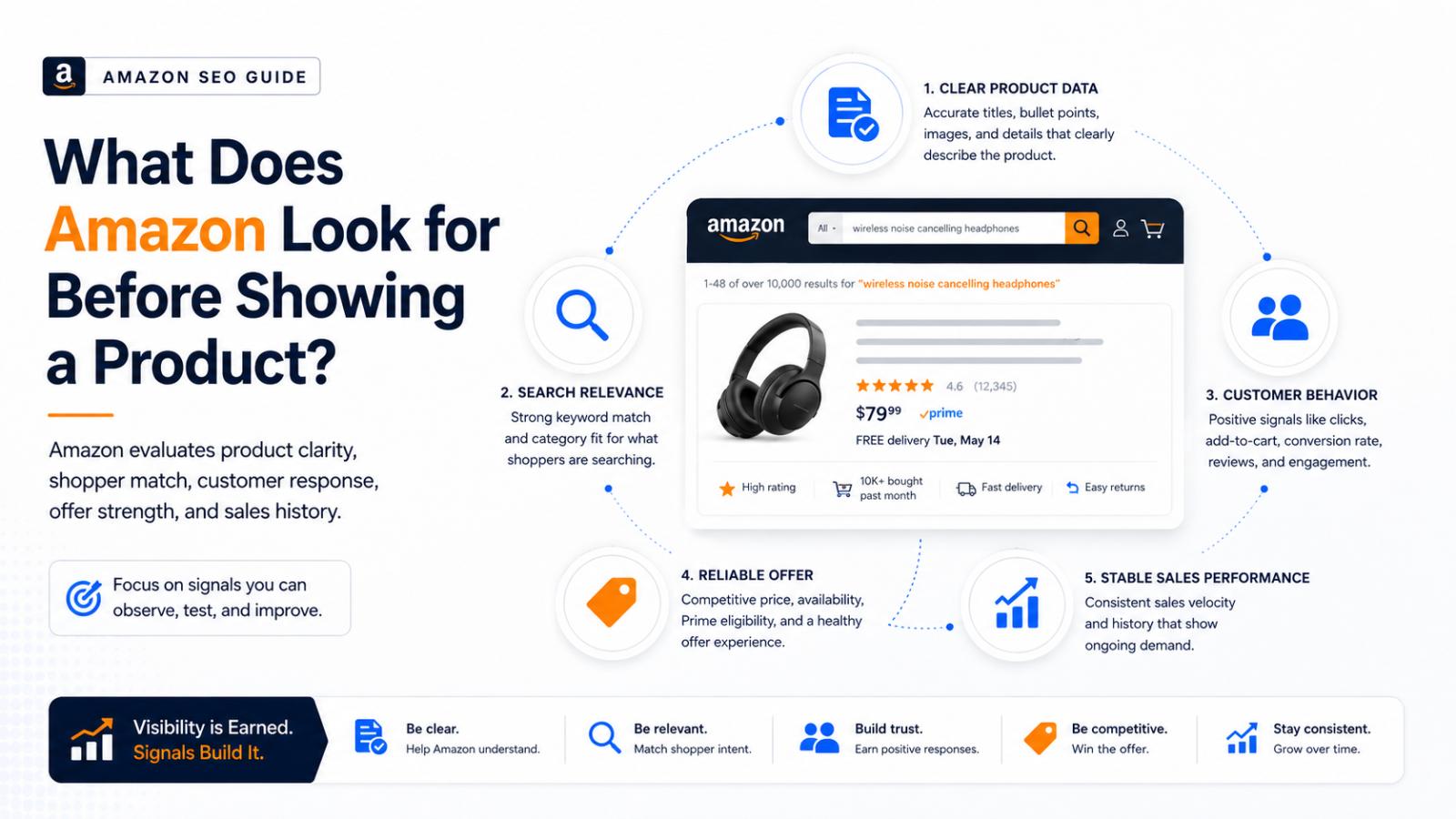
What Does Amazon’s Search Algorithm Look for Before Showing a Product?
Amazon’s search algorithm must decide whether a product belongs in a shopper’s search and whether showing it is likely to create a useful result.
The exact search algorithm is not fully public, so sellers should avoid pretending that one factor controls every outcome. Focus instead on the signals you can observe, test, and improve.
Can Amazon Clearly Understand the Product?
Amazon needs clear and consistent product data.
The title, category, attributes, bullet points, description, and other fields should all describe the same item. Conflicting details make it harder for the system to understand what the product is and where it belongs.
Start with clarity before keyword optimization.
Check whether the brand, model, size, material, use case, and key features are easy to identify. If the product data is confusing, adding more phrases will usually create more noise rather than more reach.
Does the Product Match the Shopper’s Search?
A product must be relevant to the words and intent behind a customer search.
Keyword relevance is not created by repeating a phrase many times. It comes from a clear match between the product, the search query, and the information presented on the page.
Use relevant keywords where they naturally help explain the product. Avoid forcing broad phrases into the page simply because they have high search volume.
A smaller phrase with strong search intent can be more useful than a broad phrase that attracts the wrong audience.
How Does Customer Behavior Affect Product Visibility?
Amazon can observe customer behavior after a product appears. Clicks, purchases, returns, and other actions can indicate whether the result was useful.
This does not mean every short-term movement has one simple cause, but changes in customer behavior should never be ignored.
Review customer search behavior instead of focusing only on keyword positions.
When customer behavior shows many impressions but few clicks, the issue may be presentation or offer strength. When shoppers click but rarely purchase, the problem may sit beyond SEO.
Is the Product Offer Reliable and Competitive?
A relevant listing can still lose visibility when the offer is weak.
Price, stock, delivery promise, seller reliability, and Buy Box status can affect the shopper’s decision and the product’s ability to compete.
Check competitive pricing and availability before rewriting the page.
A seller who ignores the offer may spend weeks editing content while the main blocker remains unchanged. SEO works best when the offer can support the demand it receives.
Do not optimize around an unavailable offer
Does the Product Have a Stable Sales Rank and Sales History?
Consistent demand, a stable sales rank, and a healthy sales history can support a product’s ability to remain visible.
However, sellers should not treat sales rank or Amazon sales rank as a complete SEO score. These figures reflect marketplace performance and can change by category, season, and recent activity.
Do not treat one sales rank movement or sales metric as a key ranking factor in isolation.
Use sales data as context, not as the only answer. A rise in sales velocity may support stronger visibility, while stockouts or sudden declines may weaken momentum.
The product’s sales performance should always be reviewed alongside relevance and offer health.
Maintaining consistent sales momentum is important for Amazon SEO.
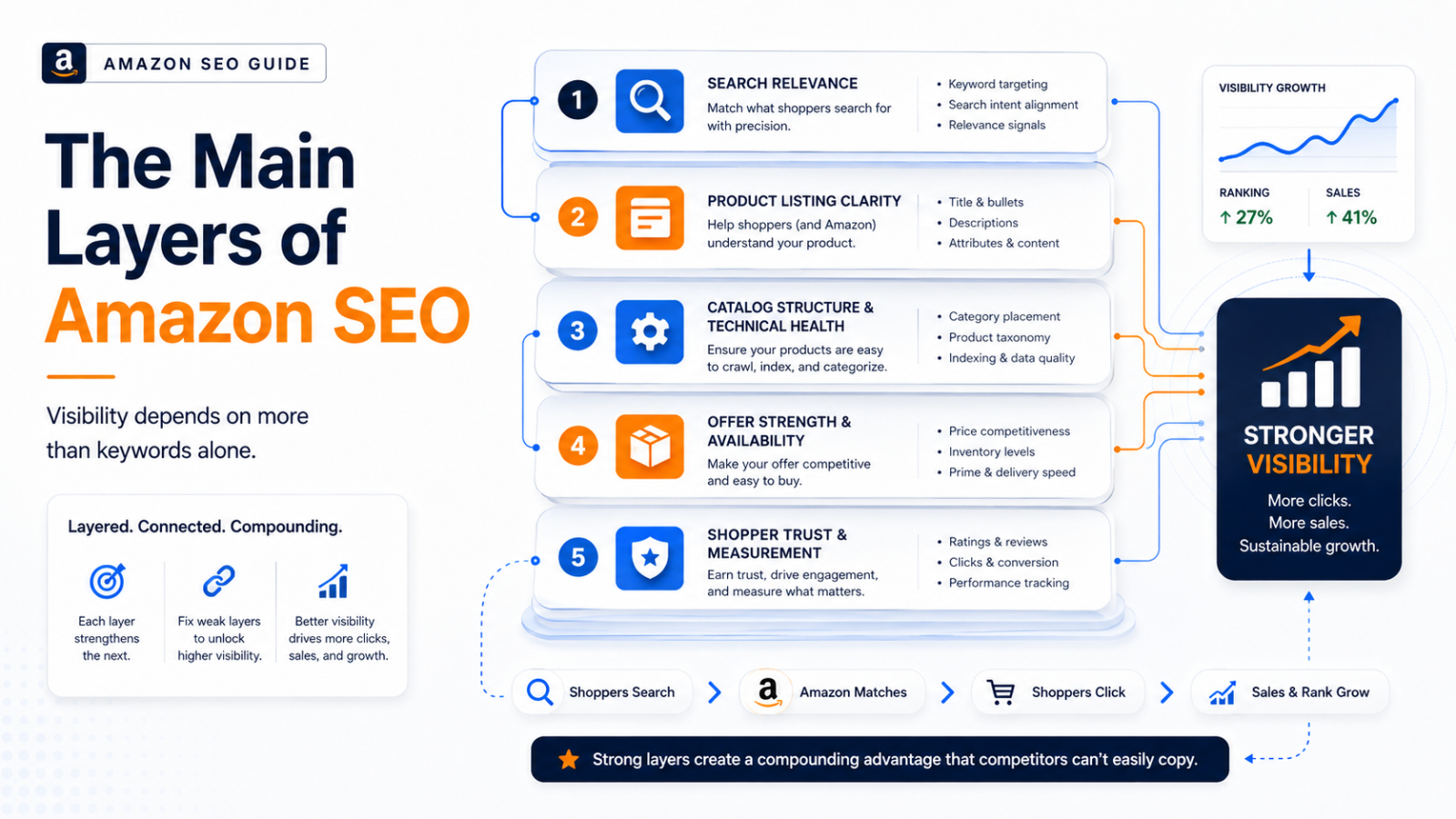
What Are the Main Layers of Amazon SEO?
A practical way to manage Amazon SEO is to divide it into layers.
This helps you avoid random edits and keeps each decision tied to a clear problem.
Search Relevance
Search relevance is the connection between a product and the phrases shoppers use.
It includes the words in customer searches, the meaning behind them, and the product data Amazon uses to make a match.
Good relevance starts with thorough keyword research, but this guide will not replace a full keyword research process.
At this stage, confirm that the main product type, use case, features, and audience are represented clearly.
Save deeper work on competitor keywords, keyword volume, long-tail keywords, and search frequency rank for a dedicated research workflow.
Successful Amazon SEO typically includes relevant keyword research and optimized product titles. Keyword optimization involves identifying high-volume relevant keywords. Using tools like Product Opportunity Explorer aids in keyword research.
Using relevant keywords in titles improves product visibility. Product titles should be concise and include primary keywords. Amazon SEO requires keyword-rich product listings for visibility.
How Clear Are Your Product Listings?
Clear product listings help both Amazon and the shopper understand the product quickly.
Product titles, bullet points, images, and supporting details should work together rather than repeat the same message across the product listings.
Do not try to optimize listings by adding every possible phrase.
Use each page to highlight key features, explain value, and reduce doubt. The goal is clearer product listings and a better customer experience, not denser blocks of text.
Listing optimization includes conducting keyword research and crafting strong titles. Optimized listings improve click-through rates and entice shoppers. An optimized listing attracts valuable organic traffic, reducing ad dependence. SEO improves click-through rates by using well-written titles and compelling images.
Amazon's algorithm rewards listings with high-quality images and descriptions. High-quality visuals increase engagement and conversion rates. High-quality images can significantly boost product visibility. Products with high-quality images rank better on Amazon.
Catalog Structure and Technical Health
The catalog layer includes category placement, product type, attributes, variations, and listing status.
Technical problems can limit reach even when the visible copy looks strong.
Review this layer when product listings are missing from expected areas, filters, or Amazon’s search.
Do not guess at a content problem until you confirm that the catalog structure is healthy. Detailed fixes belong in the separate guides on categories, variations, indexing, and suppression.
Offer Strength and Availability
The offer layer covers stock, delivery, price, and the ability to win or hold the Buy Box.
These factors are not a replacement for relevance, but they can affect how well visibility turns into traffic and sales.
Before making content changes, check whether the product can be purchased under a competitive and reliable offer.
An unavailable or weak offer can reduce the value of otherwise strong optimization strategies.
How Customer Satisfaction Supports Shopper Trust and Performance
Customer satisfaction is supported by clear information, positive reviews, reliable delivery, and a product that meets its promise.
Positive customer reviews and customer feedback can reveal confusion that the page is not addressing and show where customer satisfaction may be weakening.
Use this information to understand friction, not to manipulate shoppers.
Strong customer satisfaction and repeat purchases are more valuable for long-term performance than aggressive claims or keyword stuffing.
A steady stream of positive reviews influences search ranking on Amazon. Customer reviews significantly influence Amazon product rankings.
How Amazon Brand Registry Can Support Organic Visibility Measurement
Measurement tells you whether your work is helping, and Amazon Brand Registry can give eligible brands access to additional data for that review.
Track impressions, click activity, keyword reach, organic placement, and performance metrics over time. Do not rely on one daily rank check.
For eligible brands, tools connected to Amazon Brand Registry, Amazon Brand Analytics, and Search Query Performance may provide useful views of demand and shopper movement.
The detailed tracking process belongs in the separate organic visibility guide, but the principle is simple: use the available Amazon Brand Registry data to support your baseline before you change anything.
Where Is Your Amazon Visibility Breaking?
Most sellers do not need more tactics. They need a clearer diagnosis.
Start by locating the stage where the product loses momentum.
Start with diagnosis
Your Product Is Not Appearing in Search
When a product does not appear, first separate an indexing issue from a catalog or status problem.
Check whether the listing is active, whether the product data is accepted, and whether it appears for highly specific searches in the Amazon search box.
Do not immediately add backend keywords or rewrite the page.
The cause may involve indexing, category placement, missing attributes, or suppression. Use the dedicated product indexing and catalog error guides for the deeper checks.
Your Product Appears but Receives Few Clicks
Low clicks can mean the product is appearing for weak matches, or that the visible offer is not competitive.
Review the search context, main image, price, review level, delivery promise, and title clarity.
Do not assume the answer is always more keywords.
Compare the product with the other items shown in Amazon’s search results. Ask what a shopper can understand in two seconds and what may be causing hesitation.
Your Product Gets Clicks but Sales Conversions Stay Low
Traffic without sales conversions often points to a page, product, price, trust, or offer problem.
Review unit session percentage, customer questions, reviews, images, and product details to identify what may be limiting sales conversions.
This is where sellers must separate SEO from conversion work.
Strong visibility can bring more visitors, but it cannot force a weak offer to drive sales. A dedicated conversion review may be more useful than another SEO edit.
Why Your Search Rankings Improve and Then Drop Again
Temporary gains in search rankings can happen after a change, promotion, stock movement, or shift in demand.
Do not react to every daily change in search rankings. Compare several periods and review whether sales volume, stock, pricing, or shopper response also changed.
A drop in search rankings is a signal to investigate, not proof that one keyword was removed incorrectly.
Record the timeline and identify what changed before, during, and after the movement.
Only Branded Searches Bring Visibility
Branded visibility can be healthy, but it does not show whether the product reaches new shoppers.
Separate branded and non-branded search terms to understand whether the listing is discoverable beyond people who already know the brand.
Build relevance around the product and use case, not only the brand name.
This can help boost visibility among shoppers who describe a need rather than search for a specific company.
What Should You Fix First?
The right first move is rarely the longest task.
It is the change that removes the largest verified blocker.
Start With the Biggest Visibility Blocker
Rank possible issues by impact.
A suppressed listing is more urgent than a minor wording change. A wrong category can matter more than adding another phrase. An out-of-stock product needs a different response than a product with weak relevance.
Choose the problem that prevents all other work from performing.
Fixing a small detail while a major blocker remains is busy work, not progress.
Separate SEO Problems From Sales Problems
Not every decline in Amazon sales is an SEO issue.
Demand, competition, pricing, stock, reviews, and seasonality can all change sales performance.
Ask a simple question: is the product failing to be found, or is it being found and failing to win the sale?
This distinction keeps SEO, conversion, PPC, and offer decisions from becoming mixed together.
Check Whether the Problem Affects One ASIN or Many ASINs
A problem affecting one ASIN may come from its data, category, variation, or offer.
A problem affecting many Amazon listings at the same time may point to a broader operational, account, season, or market issue.
Use this split early.
It can save hours of editing individual pages when the real cause sits at the account or category level.
Review Recent Changes Before Making New Ones
Check what changed in your Amazon Seller Central account before you make another edit.
Review content updates, category moves, variation changes, price changes, stock events, and campaign activity.
A clear change log helps you connect cause and effect.
Without it, every new edit creates another variable and makes diagnosis harder.
Prioritize High-Impact Fixes Over Small Edits
Focus first on changes that improve understanding, access, or trust.
Correcting a product type, restoring stock, or removing conflicting data may have more value than changing several adjectives.
Do not measure effort by the number of edits.
One accurate fix can be more important than ten cosmetic changes.
Fix the blocker, not the symptom
Avoid Changing Everything at the Same Time
When multiple fields change together, you lose the ability to learn.
You may see improvement, but you will not know which action helped. You may also create a new problem while trying to fix another.
Use a controlled sequence.
Change one core area, wait for processing, observe the result, and then decide what comes next.
How Should You Make Amazon SEO Changes Safely?
Safe improvement requires a baseline, a clear reason for the change, and enough time to observe the result.
Treat each major edit as a small test.
Create a Clear Starting Point
Record current visibility, traffic, sales, stock, price, and known issues.
Note which search terms matter and where the product currently appears.
This baseline gives you something to compare against.
Without it, success becomes a feeling rather than a measurable result.
Record What You Changed and When
Keep a simple log with the date, ASIN, field changed, reason, and expected outcome.
Include content, catalog, offer, and campaign changes that could affect performance.
This habit becomes especially valuable when several people manage the account.
It prevents duplicate work and helps your team understand the history behind current results.
Change One Core Area at a Time
Group related edits, but avoid mixing unrelated changes.
For example, do not change category, price, images, and copy on the same day unless an urgent problem requires it.
A controlled process makes your conclusions stronger.
It also helps you reverse a change when the result is negative.
Give Amazon Time to Process the Change
Some updates appear quickly, while others need more time to be reflected across the catalog and search.
Do not assume a change failed because the result is not immediate.
Set a review window that fits the type of edit.
Avoid adding more changes during that window unless the listing has a serious error.
Compare the Result With the Previous Period
Compare similar periods and account for stock, promotions, seasonality, and ad activity.
Look at traffic, reach, sales, and the quality of the searches bringing shoppers to the page.
Use sales data and visibility data together.
An increase in impressions with no improvement in clicks may require a different next step than a rise in both clicks and orders.
Keep, Improve, or Reverse the Change
After the review window, make a clear decision.
Keep the change if it improved the right outcome. Improve it if the direction is promising but incomplete. Reverse it when it creates confusion or weakens performance.
Do not leave weak changes active simply because time was spent creating them.
Good optimization is a process of learning, not defending every edit.
Which Amazon SEO Mistakes Hurt Visibility the Most?
Many visibility problems come from rushed decisions rather than a lack of tools.
Avoid the following patterns before adding more work.
Treating Amazon SEO as Keyword Stuffing
Keyword stuffing can make a page harder to read and less useful to shoppers.
Repeating the same phrase does not automatically create stronger relevance.
Use search terms to support clear product information.
The page should sound natural, explain the item, and help a shopper make a decision.
Keyword stuffing can harm product rankings on Amazon.
Copying Competitor Listings Without Understanding the Product
A competing page may have a different brand position, price, audience, review profile, and sales history.
Copying its structure or language can create a mismatch with your own product.
Study competitors for context, but make decisions based on your product and customer expectations.
Competitor research should inform your approach, not replace it.
Repeating the Same Search Terms Everywhere
Repeating phrases across every visible field and backend search terms wastes space and can reduce clarity.
Each field should have a purpose.
Use product titles for identification, bullet points for value and features, and backend keywords for useful terms that do not fit naturally on the visible page.
Keep the deeper backend process for dedicated optimization work.
Making Frequent Changes Without a Clear Reason
Frequent edits create unstable data and make it difficult to connect action with outcome.
They can also interrupt a period in which the listing needs time to settle.
Create a hypothesis before every major change.
State what problem you expect the edit to solve and what metric should improve.
Ignoring Catalog and Category Problems
Content cannot fully overcome an incorrect category, product type, or broken variation.
These issues can limit filtering, browsing, and search access.
Confirm catalog health early.
When the structure is wrong, move the task to the relevant technical workflow instead of continuing to optimize product listings at the surface level.
Focusing on Rankings but Ignoring Shopper Behavior
A product can hold a good position and still create weak business results.
Search placement without clicks or purchases is not a complete win.
Review customer behavior, click response, and sales performance.
The goal is not only to reach a position; it is to reach the right shoppers with an offer they understand.
Using PPC Results as Proof of Organic Growth
Sponsored Brands, Sponsored Brand ads, and other paid placements can increase traffic, but paid exposure is not the same as organic growth.
Campaign activity may temporarily change sales and visibility without proving that organic relevance improved.
Separate paid and organic reporting where possible.
Use marketing strategies to support the business, but do not label every paid result as an SEO gain.
External traffic boosts Amazon product rankings significantly. Amazon's A10 algorithm rewards products with external traffic. Using Google Ads can improve organic rank on Amazon. Amazon Attribution tracks external traffic sources for product sales.
External traffic significantly boosts organic ranking on Amazon. External traffic boosts product rankings on Amazon's A10 algorithm. Amazon's A10 algorithm emphasizes external traffic for ranking.
Trying to Fix Every ASIN the Same Way
Different products can have different visibility blockers.
One may need clearer relevance, another may have a catalog issue, and another may simply face weak demand.
Build optimization strategies by problem type.
A standard checklist is useful, but the final action plan should reflect the product, category, and evidence.
What Should Your First 30 Days of Amazon SEO Look Like?
The first month should create clarity, not chaos.
Use it to find the main problem, make controlled improvements, and build a repeatable process.
Week 1 — Find the Main Visibility Problem
Start with a basic audit.
Review active status, search presence, important queries, category placement, offer health, traffic, and recent changes.
Identify whether the biggest issue is discovery, click response, conversion, or technical access.
Do not begin with a full rewrite.
Your goal in week one is to create a ranked list of blockers and choose the first one to address.
Week 2 — Improve Relevance and Product Clarity
Review whether the page clearly explains what the product is, who it is for, and what makes it useful.
Use keyword research as support, but do not turn the page into a phrase list.
Choose the most relevant wording, remove conflicting details, and make sure the visible content matches search intent.
Deeper work to optimize product listings should remain inside the listing and keyword service workflows.
Week 3 — Review Catalog and Offer Blockers
Check category, product type, attributes, variation structure, listing status, stock, delivery, pricing, and Buy Box position.
These areas can block visibility or weaken shopper response even when the copy is strong.
Escalate technical problems to the correct workflow.
Do not use content edits to hide a catalog problem or use advertising to hide an unavailable offer.
Week 4 — Measure the Change and Choose the Next Step
Compare the new period with the baseline.
Review impressions, clicks, orders, keyword reach, sales rank movement, and any changes in customer behavior.
Choose the next step based on evidence.
You may keep the change, refine it, or move to another blocker. Tools such as Manage Your Experiments can support structured testing in suitable cases, but testing should still begin with a clear question.
When Is Amazon SEO Not the Real Problem?
A seller can waste time on SEO when the real issue is demand, offer quality, product-market fit, or conversion.
Recognizing this early protects time and budget.
The Product Has Weak or Unclear Demand
A product cannot create unlimited demand through optimization.
Low search volume, narrow use cases, or unclear customer need may limit opportunity.
Review the market before assuming the page is broken.
Product research and demand analysis may be the correct next step when customer searches are limited or inconsistent.
The Price Is Not Competitive
A product can be relevant and visible but still lose clicks or purchases because the price feels too high for the category.
This is especially important when nearby offers appear similar.
Check competitive pricing before rewriting the page.
A price problem should be handled as an offer decision, not disguised as a keyword problem.
The Product Is Frequently Out of Stock
Repeated stockouts can interrupt sales volume, customer access, and performance history.
SEO cannot create stable growth for an item that is often unavailable.
Coordinate inventory planning with visibility work.
Restoring stock should come before aggressive efforts to drive more traffic.
The Offer Does Not Build Enough Trust
Slow delivery, an unfamiliar seller, unclear returns, or loss of the Buy Box can create hesitation.
The page may receive traffic while the offer fails to feel safe or convenient.
Review the complete buying experience.
Trust is built by the product, page, seller, and delivery promise together.
Reviews Create Doubt for Shoppers
A high number of reviews does not always mean strong trust.
Recent complaints, repeated product issues, or unclear expectations can reduce purchase confidence.
Read customer reviews for patterns.
Use them to improve the product, instructions, and page clarity. Review management belongs in its own service area, but the SEO team should still recognize when reviews are the real blocker.
Paid Traffic Is Hiding Weak Organic Performance
Advertising can keep traffic and revenue moving while organic reach remains weak.
This can make the account look healthy until ad spend changes.
Separate paid traffic from organic traffic in reporting.
Review whether the product can still attract and convert shoppers without relying completely on paid placement.
The Product Page Gets Traffic but Cannot Convert It
When traffic is healthy but orders are weak, the main issue may be conversion rather than discovery.
Images, copy, reviews, price, product quality, or the offer may fail to meet customer expectations.
Move the task to a conversion-focused review.
SEO should not be blamed for every weak unit session percentage.
What Does Sustainable Amazon Search Visibility Look Like?
Sustainable visibility is not a permanent number.
It is a stable system that helps the product remain discoverable, understandable, and competitive as demand changes.
Your Product Appears for Relevant Searches
The product should appear for searches that fit its real use, features, and audience.
Broad visibility is not useful when it attracts shoppers who are unlikely to buy.
Monitor the quality of the queries, not only the count.
Strong reach begins with relevant matching.
Visibility Is Not Dependent on One Keyword
A product that relies on one phrase is vulnerable to competition and demand shifts.
Build a wider relevance base around the product type, features, problems solved, and natural long-tail keywords.
This does not mean adding hundreds of phrases.
It means creating a clear product identity that can match several useful forms of demand.
Organic Traffic Remains More Stable Over Time
Organic traffic will still move with seasonality, competitors, pricing, and demand.
The goal is not a flat line, but a more stable pattern that is not fully dependent on ads or one temporary promotion.
Track trends over meaningful periods.
Short daily changes should not control your strategy.
Shoppers Understand the Product Quickly
A strong page reduces the time needed to understand the item.
The title, image, price, reviews, and key features should create a clear first impression.
Clarity supports both discovery and decision-making.
When shoppers understand the product quickly, traffic has a better chance to turn into more sales.
SEO Changes Can Be Measured Clearly
Every major change should have a reason, baseline, and review date.
This makes improvement repeatable and helps the team avoid random decisions.
Use performance metrics that fit the problem.
Visibility issues require different measures from conversion, inventory, or advertising issues.
Your Team Knows What to Fix Next
A mature SEO process creates a clear queue of issues.
The team knows which ASINs need attention, which problem type each one has, and what evidence supports the next action.
This is more valuable than chasing every new tactic.
A clear system helps improve Amazon ranking over time without constant reactive editing.
Amazon SEO Checklist
Use this checklist as a diagnostic tool.
It should help you decide where deeper work is needed, not replace the specialist process behind each area.
Can Amazon Understand Your Product?
Confirm that the product type, brand, model, size, material, use case, and main features are consistent.
Remove conflicting data before adding more keywords.
Can Relevant Shoppers Find the Product?
Check whether the product appears for specific, accurate searches and whether the queries match its real purpose.
Do not use one broad phrase as the only test.
Does the Product Page Match Search Intent?
Read the page from the shopper’s perspective.
Make sure it answers the main questions behind the search query and does not promise something the product cannot deliver.
Are Catalog and Technical Details Correct?
Review category, product type, attributes, variations, listing status, and known errors.
Move deeper technical issues to the indexing, category, variation, or suppression guide.
Is the Offer Strong Enough to Support Visibility?
Check stock, price, delivery, seller status, and Buy Box position.
Strong relevance cannot fully compensate for an offer shoppers avoid.
Can Shoppers Trust the Product?
Review positive reviews, recent complaints, returns, images, claims, and customer feedback.
Make sure the page sets accurate expectations.
Are You Measuring Organic Changes?
Track organic reach, traffic, query quality, sales data, and the date of each major edit.
Where available, use Amazon Brand Analytics and Search Query Performance to add context.
Do You Know Which Problem to Fix Next?
Choose one verified blocker and define the expected result.
When you cannot explain why a change should help, gather more evidence before making it.
Need help finding the real SEO blocker?
Testmarket can help review visibility, catalog health, offer blockers, and performance trends so your next Amazon SEO move is based on evidence.
Frequently Asked Questions About Amazon SEO
Frequently Asked Questions About Amazon SEO
Amazon SEO is the process of improving a product’s ability to be understood, matched, and shown within Amazon’s marketplace. It includes relevance, catalog health, offer strength, shopper response, and measurement. It is broader than simple keyword optimization and should be managed as an ongoing system.
The timing depends on the type of change, the product, the category, demand, sales history, and Amazon’s processing. Some updates appear quickly, while performance changes need a longer review period. Use a baseline and avoid judging a major edit from one or two days of data.
SEO focuses on organic discovery and relevance. PPC uses paid placements to reach shoppers through sponsored ads. They can support the same business goal, but they should be measured separately. Paid traffic can drive sales, while organic work aims to improve unpaid visibility and search matching.
Yes, a product can gain organic visibility without paid ads, but the result depends on demand, relevance, offer quality, competition, and performance. Ads may support exposure and sales velocity, yet they do not replace clear product data, a healthy catalog, or a competitive offer.
Possible causes include indexing problems, category or product type issues, missing data, listing suppression, inactive status, or a weak match with the query. Start with a specific search test and listing status check. Then use the dedicated indexing or catalog error guide for a deeper diagnosis.
A listing change can affect relevance, shopper response, and visibility, but not every edit creates a clear ranking movement. The effect depends on what changed and whether it improved the product’s match with customer demand. Record changes and compare results before making another major edit.
Review high-level trends regularly and run deeper reviews after meaningful changes or noticeable performance shifts. The exact schedule depends on sales volume and account size. Avoid reacting to daily noise; use weekly and monthly patterns to guide decisions.
No. Demand, competitors, catalog data, pricing, stock, customer expectations, and the Amazon search algorithm can change over time. The goal is not constant editing, but ongoing monitoring and controlled improvement when evidence shows a real need.
First confirm whether the decline affects one ASIN or many. Then check listing status, indexing, catalog changes, stock, price, Buy Box, traffic sources, and recent edits. Fix the largest verified blocker before making small content changes.
An audit is useful when visibility drops, a product fails to appear for relevant searches, paid traffic hides weak organic performance, or the team cannot agree on the cause. It can also help before a major optimization project by creating a clear baseline and priority list.
Testmarket can review organic visibility, product data, indexing signals, catalog health, offer blockers, and performance trends to identify where growth is being lost. The aim is not to change every field. It is to find the highest-impact issue, connect it to the right service area, and create a practical action plan that helps sellers optimize listings, protect organic reach, and make better decisions from real sales data.
Grow your sales with Testmarket
Launch products, collect authentic reviews and run deals that convert — start free.