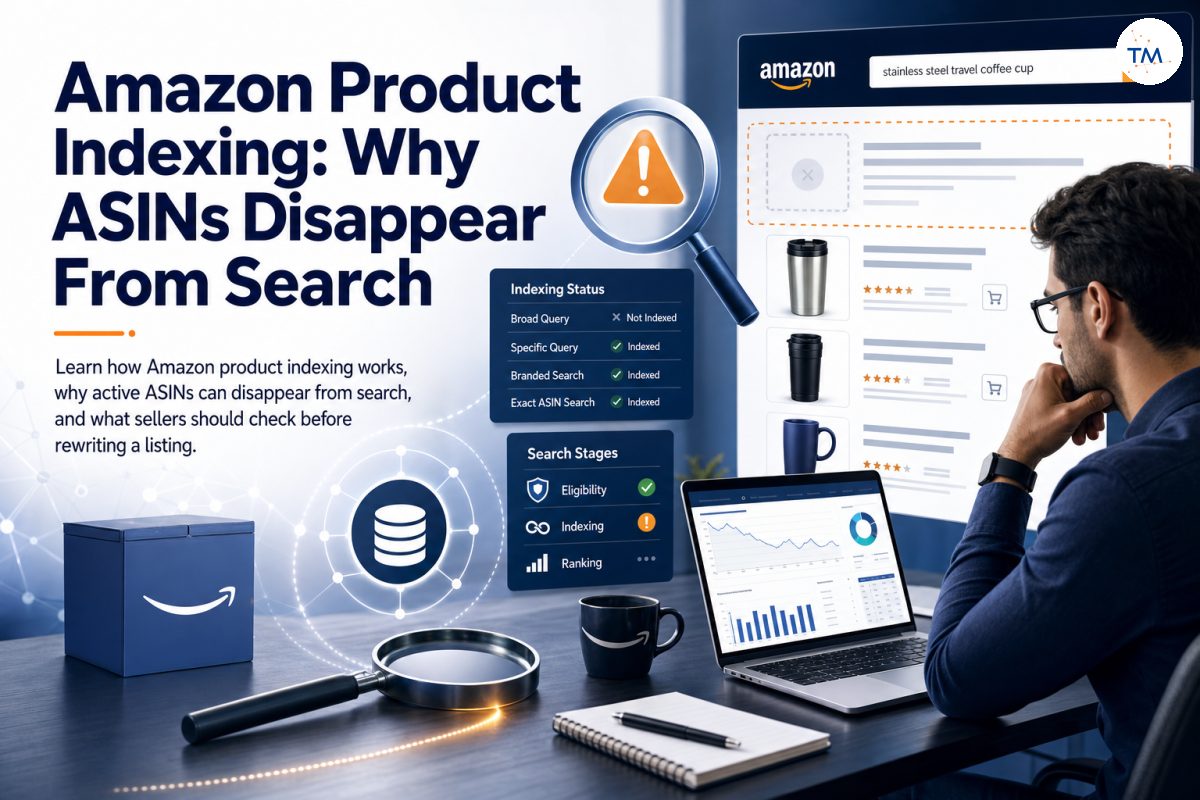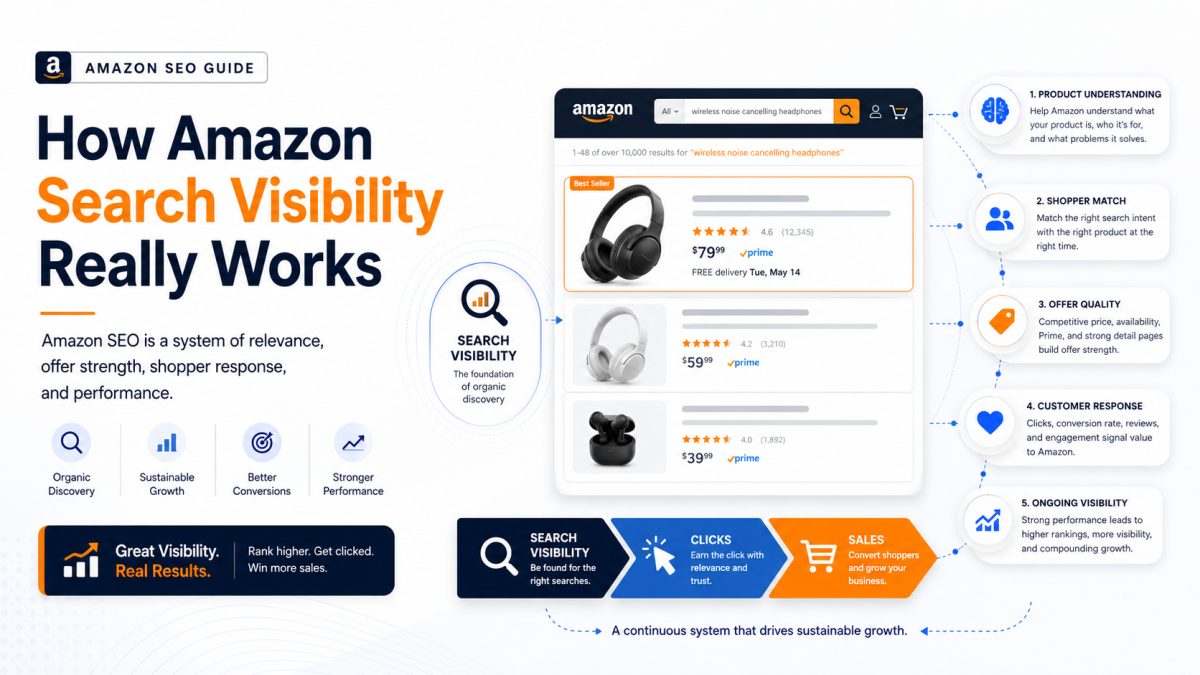




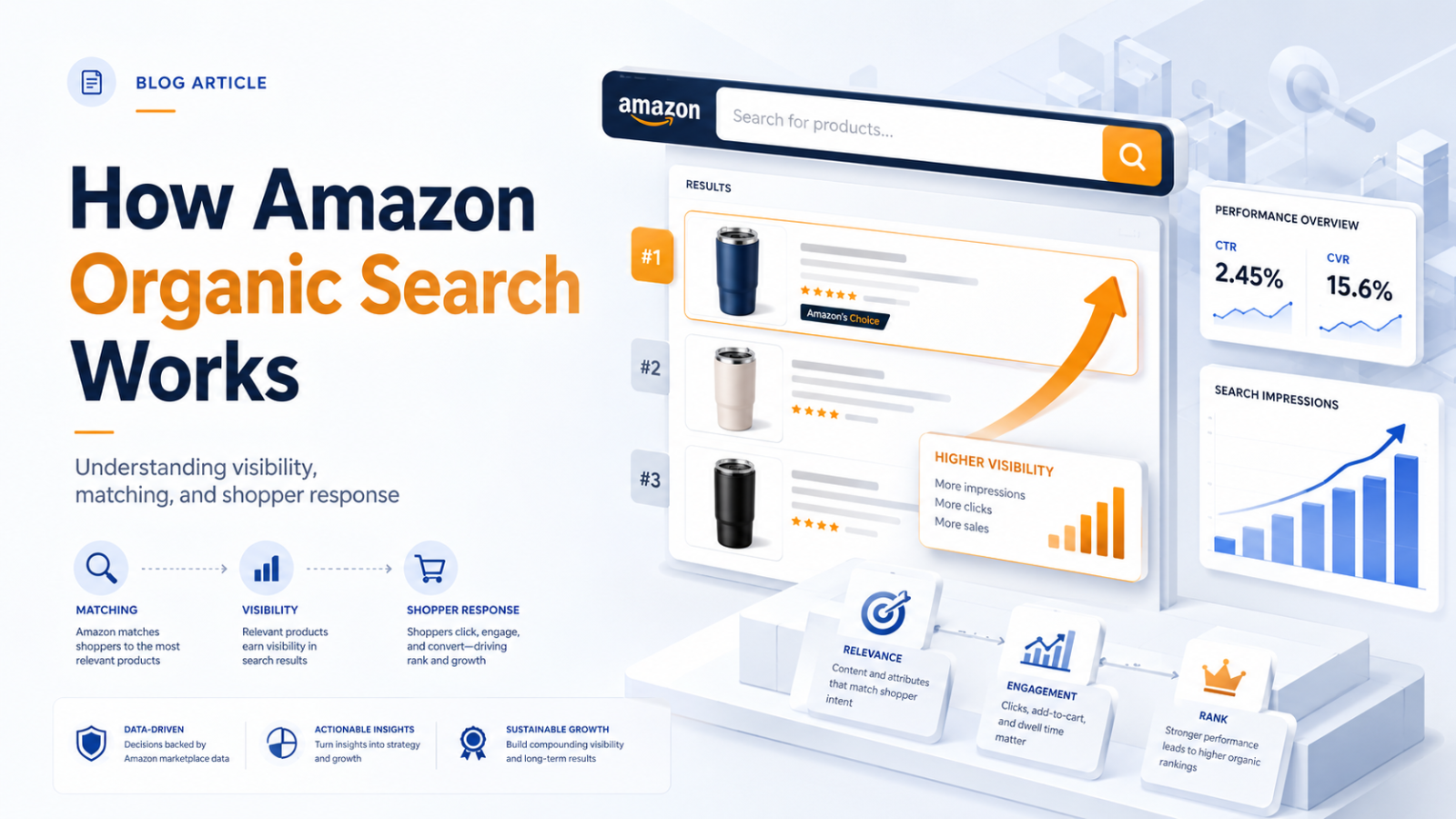
How Amazon Organic Search Works

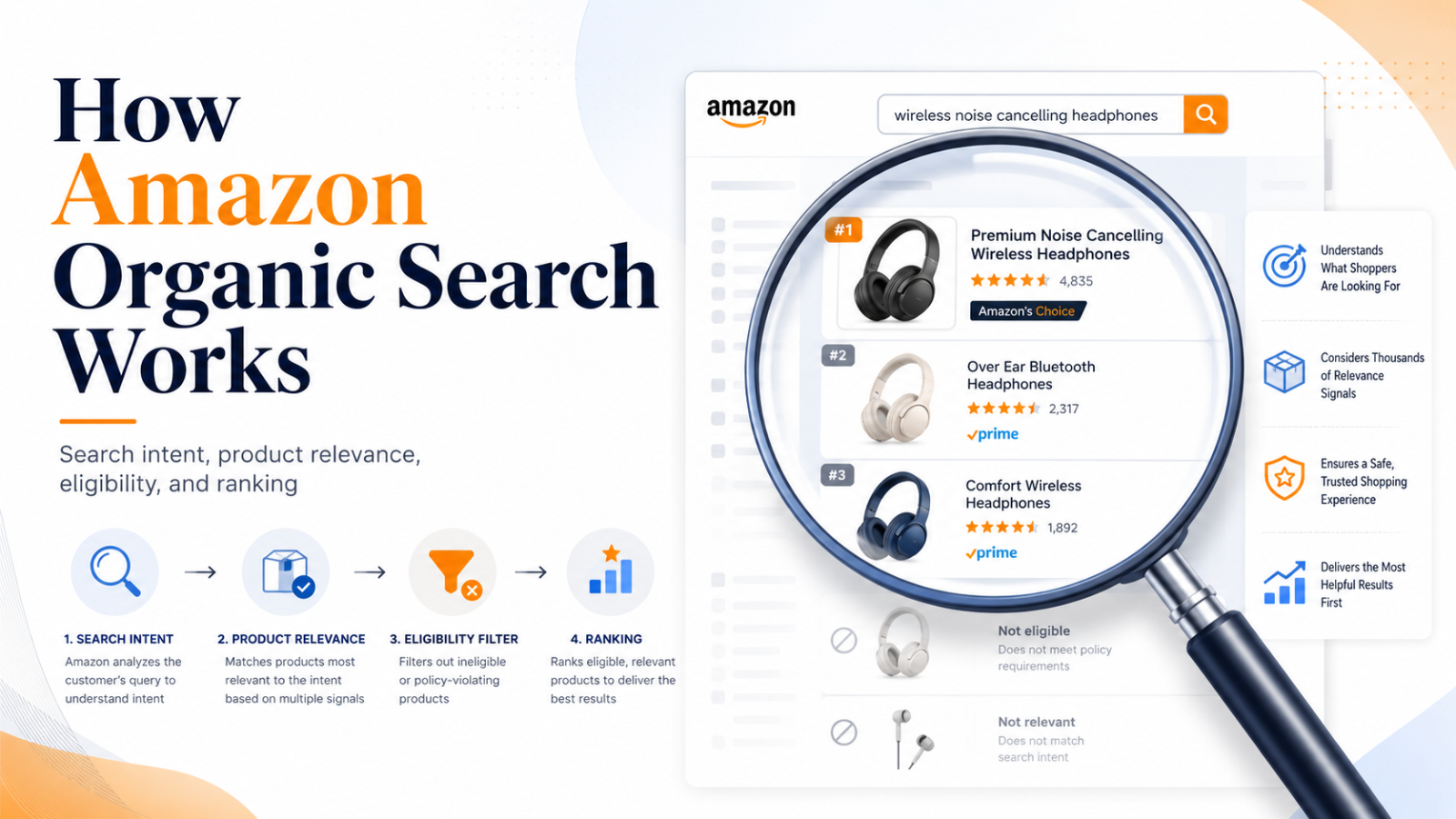
Amazon organic search is the system that decides whether a product can appear for a shopper’s query and where that product may be placed among other eligible results. It is not based on one permanent rank, one keyword, or one isolated performance signal.
This guide explains what happens after a shopper enters a search query, how Amazon identifies possible product matches, how matching differs from ranking, and why the same ASIN can hold different positions across similar searches. You will also learn how to diagnose weak search matching without immediately rewriting the entire listing.
This guide is for Amazon sellers, brand owners, and marketplace teams that want to understand why a product appears, disappears, ranks low, or attracts visibility from the wrong searches.
Understanding this process matters because many sellers treat every visibility problem as a keyword problem. That often leads to unnecessary edits, wasted cost, and unclear results. When you know whether the issue comes from eligibility, matching, ranking, shopper response, or the offer, you can choose the correct next action instead of changing everything at once.
For sellers, the practical goal is to understand the full process:
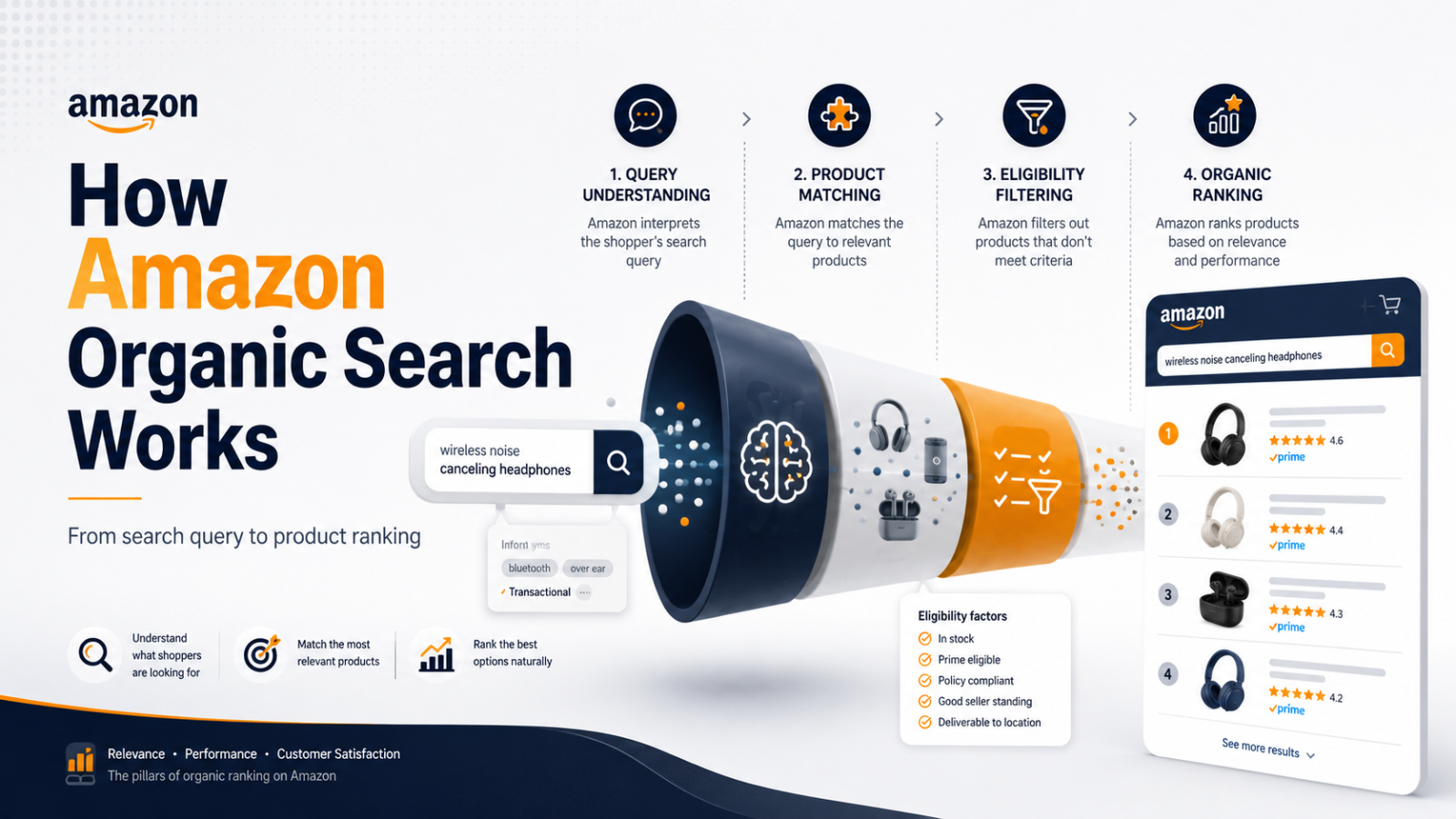
- Amazon interprets the query.
- It identifies possible product matches.
- It removes products that are not eligible.
- It orders the remaining products for that exact search.
Your role is not to guess every detail of the algorithm. Your role is to identify where the product loses visibility and take the smallest set of useful actions.
What Happens After a Shopper Types a Search Query?
When a shopper enters a phrase, Amazon must quickly understand what the shopper may want to purchase. It then compares that need with a large catalog containing thousands of possible products.
The results are not random. Every product must first qualify as a possible match before it can compete for a stronger organic position.
Amazon Interprets the Meaning Behind the Query
Amazon does not only read individual words. It also considers how those words work together.
For example, a shopper searching for “wooden building blocks for toddlers” is not simply asking for wood, blocks, or toddler products separately. The shopper is probably looking for a specific type of toys product with a clear age and use case.
Start by asking:
- What does the shopper probably want?
- Is the query broad or specific?
- Does it describe a product, use case, audience, material, or problem?
- What type of product would reasonably satisfy that need?
Do not begin by counting keyword repetitions. Begin with meaning.
How Amazon Builds Potential Matches for Branded Products and Alternatives
After interpreting the query, Amazon can build a set of products that may fit it.
This potential set may include branded products, generic alternatives, premium options, low-cost items, and offers from both large sellers and small businesses. A branded search may create a narrower set, while a broad product query may allow several brands and unbranded alternatives to compete.
A product does not need to be the strongest result at this stage. It only needs to provide enough relevant information to become a possible match.
Think of this as an early selection stage. Amazon is asking:
Could this product reasonably help these customers?
If the answer is unclear, the product may never reach the ranking stage for that query. Do not assume that brand recognition alone guarantees entry. Even established branded products need a logical connection with the shopper’s search.
Ineligible Products Are Removed Before Ranking Begins
Not every possible match is allowed to compete.
A product may be removed because it is unavailable, inactive, restricted, missing important information, or not eligible under the shopper’s current search conditions.
Location can also affect availability. A product accessible to shoppers in Seattle, Washington may not be available under the same terms in Japan. Delivery options, seller eligibility, and Prime availability can also change what the shopper can see.
Local delivery networks and available drivers may affect the delivery promise shown to the shopper, but this should not be confused with the product’s relevance to the search query.
Do not confuse removal with weak ranking. When a product is not eligible, content improvements alone may not solve the issue.
That is why the first step is always to confirm whether the product can appear before asking why it ranks low.
Do not skip eligibility
Eligible Products Are Ordered for That Specific Search
Once ineligible products are removed, Amazon orders the remaining matches for that query.
The order can reflect relevance, shopper response, product performance, offer quality, availability, and other contextual signals.
Do not think of this as one global list. The order is rebuilt around the current search, shopper context, and available products. Products shown across amazon's lists are not placed in one permanent sequence that applies to every shopper and every query.
A product may rank strongly for one query and weakly for another because each query creates a different competitive environment.
How Does Amazon Decide Whether a Product Matches a Search?
Search matching begins with the product’s identity.
Amazon needs enough consistent information to understand what the product is, how it may be used, and which customers may find it relevant.
Your goal is not to make the product match everything. Your goal is to make it clearly match the searches that matter.
Product Relevance Starts With Clear Product Identity
A product should have a clear identity before it can build strong search relevance.
Amazon may use the title, product type, attributes, categories, description, and other structured information to understand the item.
Ask these questions:
- What exactly is the product?
- Who is it for?
- What is its main use?
- What important feature separates it from similar items?
- Is the product information consistent across the entire page?
If one section describes a premium office product while another presents it as a children’s toy, Amazon may receive mixed signals.
Clarity comes before reach.
Product titles should place the primary keyword near the beginning and include essential information.
Using back-end search terms effectively allows sellers to include hidden keywords in their listings.
Search Matching Depends on Meaning, Not Repetition Alone
Repeating a phrase does not automatically strengthen the match.
A seller may add the same term to the title, bullets, description, and other content, yet still fail to appear for the query because the product does not strongly fit the shopper’s intent.
Focus on meaning.
A product should explain:
- What it is
- What it does
- Who should use it
- When it is useful
- Why it fits the query
You are responsible for making the product understandable. Amazon is responsible for deciding whether that product belongs in the result set.
Do not try to control the system through repetition. Build a clear connection between query and product.
Product Data Helps Amazon Understand Context
Product data gives Amazon context beyond visible words.
Attributes, size, color, material, age range, compatibility, and intended use can all help define where a product belongs.
For example, two products may both include the word “case.” One could be a phone case, while the other could be a travel case sold in larger packages. Their visible words overlap, but their product context is different.
Review structured data as carefully as visible copy.
If the product data and content tell different stories, matching can become less reliable.
Structured data matters
Search Intent Changes Which Products Are Relevant
A single product word can represent several shopper needs.
Someone searching “running shoes” may want general footwear. Someone searching “waterproof trail running shoes” has a much more specific need.
The second query may change:
- The ideal material
- The expected pricing
- The relevant product features
- The likely purchase goal
- The competitive products
Do not assume that every related query should produce the same results.
Search intent decides what relevance means in that moment.
Relevance Can Be Different for Every Search Query
Relevance is not a permanent product property.
A product can be highly relevant to one phrase, somewhat relevant to another, and almost irrelevant to a third.
For example, a premium lunch container might fit:
- “stainless steel lunch box”
- “leakproof lunch box for work”
- “adult lunch container”
It may be much weaker for:
- “cheap plastic food box”
- “kids school lunch kit”
- “disposable meal containers”
The product has not changed. The shopper’s need has.
Judge relevance query by query.
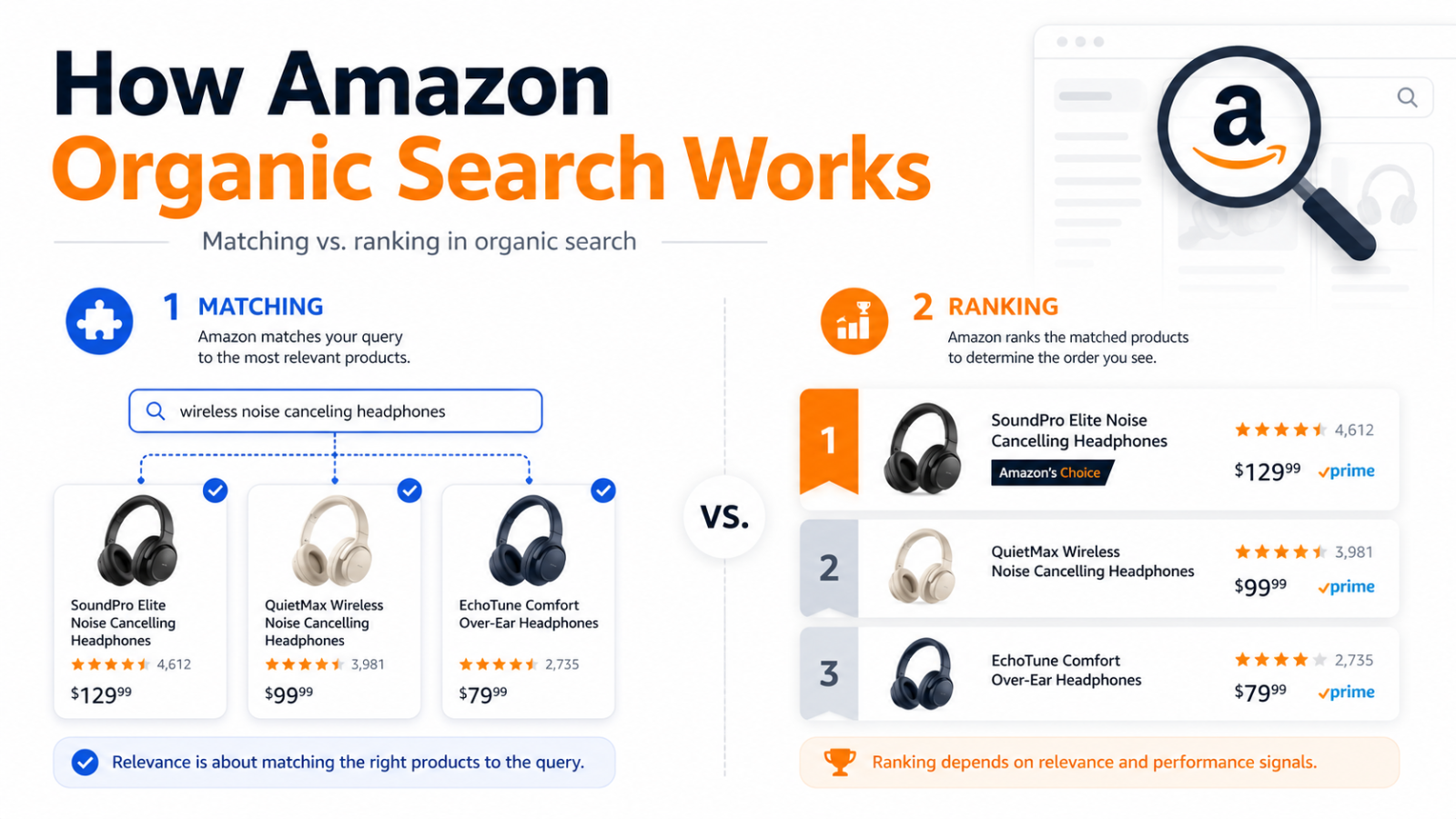
What Is the Difference Between Matching and Ranking?
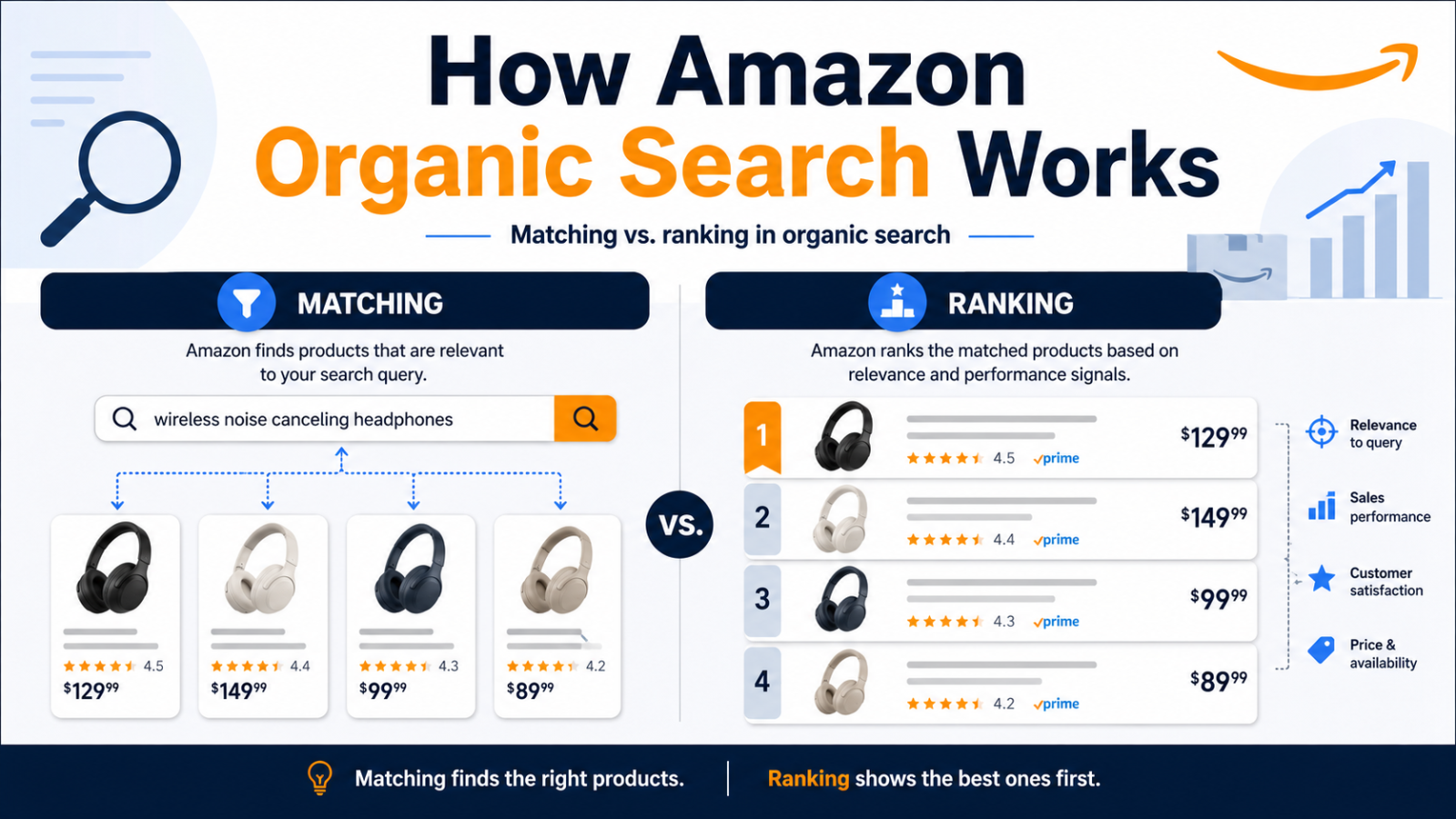
Matching and ranking are connected, but they are not the same stage.
This distinction is one of the most useful ideas in Amazon organic search.
Matching Determines Whether a Product Can Appear
Matching answers this question:
Is the product relevant enough to be considered for this search?
A product that does not match the query cannot meaningfully compete for position.
When diagnosing visibility, first ask whether the product qualifies as a potential result. Do not immediately assume that a low position is the only issue.
If the product is absent from searches that strongly fit its identity, another specialist workflow may be needed.
Ranking Determines Where the Product Appears
Ranking begins after the product becomes an eligible match.
Amazon then compares it with other products that may satisfy the same query.
The system may evaluate signals connected to:
- Query relevance
- Shopper activity
- Sales performance
- Offer conditions
- Availability
- Product history
Ranking answers a different question:
Among the eligible products, which ones should appear first?
Do not mix these two stages when planning changes.
Matching comes before ranking
A Product Can Match Without Ranking High
A product may match a query but still appear far below stronger results.
This is common when:
- Many products satisfy the same search
- Competing offers are more attractive
- Shoppers choose other products first
- The query is broad
- The product has limited recent performance
This does not always mean the page needs more keywords.
When matching already exists, your next task is to identify why competing products receive stronger placement.
A Product Can Rank Differently Across Similar Searches
Small changes in wording can change the result order.
A product may rank well for:
“small desk lamp for bedroom”
but perform weakly for:
“desk lamp”
The first phrase offers more context. The second creates a much larger competitive field.
Even virtually identical phrases can produce different results when one word changes the implied audience, feature, or use case.
Do not combine similar phrases into one conclusion. Review them separately before deciding that the product has a general visibility problem.
Organic Position Is Query-Specific, Not Universal
An ASIN does not have one permanent organic rank.
It can have different positions across:
- Broad searches
- Specific searches
- Branded searches
- Feature-based searches
- Use-case searches
A ranking tool may report one observed position, but that position belongs to a specific query and observation point.
Treat every rank as context, not as a universal product score.
How Are Eligible Products Ordered in Organic Search?
Amazon must separate many eligible products that all appear relevant.
The exact weighting is not publicly fixed, so sellers should avoid building strategies around one assumed factor.
Use a layered review instead.
Relevance Gives the Product a Chance to Compete
Relevance is the entry point.
If a product does not strongly fit the query, strong sales in another area may not make it the best result for that search.
Start by confirming that the product’s main identity, use, and features align with the query.
Do not invest in deeper ranking work until the basic match makes sense.
Shopper Response Helps Separate Similar Products
When several products appear relevant, shopper response may help separate them.
Amazon can observe whether shoppers:
- Click the result
- Continue viewing the page
- Complete a purchase
- Return to the search
- Choose a competing product
- Make returns
One action does not explain everything. Patterns are more useful than isolated events.
If shoppers consistently ignore a result, that can be a sign that the product is not meeting their expectations in that search context.
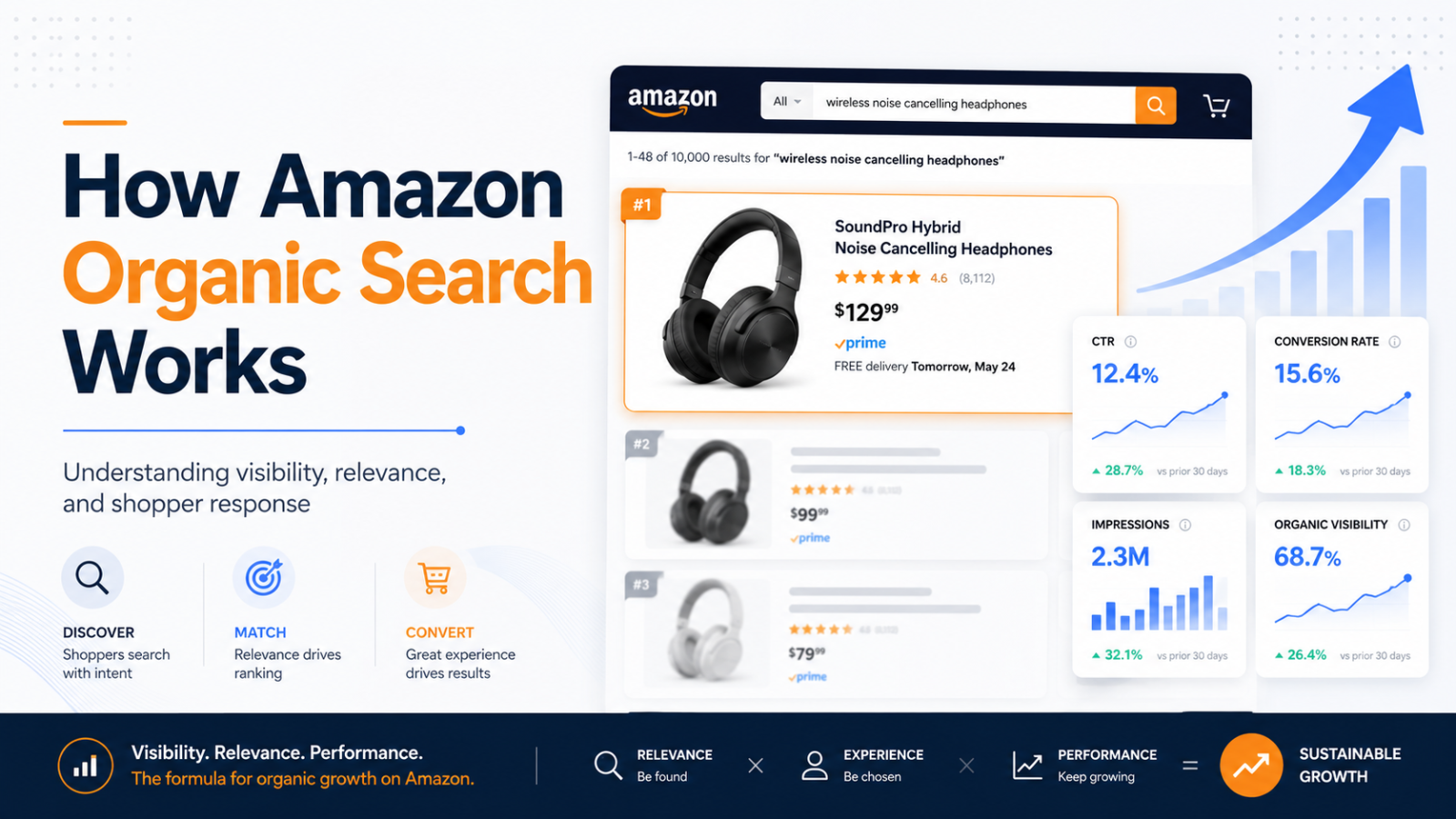
Click-through rate (CTR) measures how often shoppers click on a product after seeing it in search results.
Conversion rate (CVR) is the percentage of clicks that turn into orders, influenced by product presentation.
High conversion rates indicate to Amazon that a listing is high-quality and meets customer expectations.
Positive customer reviews improve buyer confidence and can lead to better conversion performance.
Sales Performance Provides Additional Context
Sales performance can provide context about whether a product successfully turns visibility into purchases.
However, do not treat total sales as the only ranking explanation.
A product may sell very well through branded demand but remain weak for non-branded searches. Another may have lower total volume but a stronger fit for a specific query.
Review sales in relation to the search, not only at the account level.
Sales velocity is crucial for ranking on Amazon as it reflects how fast and consistently products sell.
Offer Availability Can Support or Weaken Placement
A strong match becomes less useful when the offer is unavailable or difficult to purchase.
Review:
- Stock
- Delivery speed
- Seller status
- Prime eligibility
- Price
- Current deal conditions
A limited-time deal can change shopper response, but it should not be treated as permanent organic strength.
Before editing content, confirm that the offer can support the traffic you want to attract.
Historical Performance Can Affect Stability
Products with a stable history may show more consistent search behavior than products with frequent interruptions.
However, history should not be viewed as permanent protection.
A successful launch may create early momentum, but the product still needs to remain relevant, available, and useful to shoppers.
Likewise, one weak month does not automatically destroy long-term visibility.
Look at direction and consistency rather than one short period.
No Single Signal Controls Every Organic Result
Avoid statements such as:
- Reviews control ranking.
- Sales control ranking.
- Keywords control ranking.
- Price controls ranking.
Each factor may have a role, but no single signal explains every result.
A useful organic search review combines relevance, behavior, product performance, and offer context.
Why Can Two Similar Products Rank Differently?
Two product pages can look almost identical to a seller while sending different signals to Amazon and shoppers.
Do not assume similarity on the surface means equal search strength.
They May Match Different Parts of the Search Intent
Two products may share the same general type but serve different shopper needs.
For example, two laptop bags may differ in:
- Size
- Material
- Professional use
- Travel use
- Protection level
- Price
One may fit a student searching from a campus, while another may fit office employees or delivery workers.
The products look similar, but the intended customer and use case differ.
Why Customers May Respond Differently to Each Result
Two relevant products can receive very different reactions from customers.
One result may earn more clicks because its value is easier to understand. Another may be technically relevant but fail to communicate its main benefit quickly enough. Customers often make an early judgment before opening the page, so the visible search result matters.
Compare what customers can see:
- Main image
- Title
- Price
- Rating
- Delivery
- Prime status
- Deal badge
High-quality images improve click-through and conversion rates on Amazon listings.
Over 60% of clicks go to the top three organic search results on Amazon.
A highly rated product may receive stronger attention, but rating alone does not explain every position. Ask which result gives customers the clearest reason to click and whether that reason matches the original query.
Their Offer Conditions May Not Be Equal
The products may differ in price, shipping time, availability, return terms, or Buy Box conditions.
A seller may focus on content while ignoring the commercial conditions surrounding the offer.
Ask whether both products are truly competing under equal conditions.
A $20 product and a $45 product may attract different customer expectations even when their visible features are similar.
Their Sales Histories May Be Different
One product may have stable sales across several months. The other may have launched recently, lost stock, or depended on short promotions.
Compare the timeline.
A product that performed well in June, went out of stock in July, and returned in November may behave differently from one with stable availability throughout the year.
Search strength can reflect a history of several connected events, not one current screenshot.
Their Product Data May Send Different Signals
Two listings may use similar visible wording but have different structured data.
One may be placed in the correct category with complete attributes. The other may have missing or confusing information.
Do not compare titles alone.
The hidden source of the difference may be product data rather than visible copy.
Similar Listings Do Not Always Have Similar Search Strength
Treat each ASIN as its own project.
Review:
- Query relevance
- Product identity
- Offer status
- Shopper response
- Sales context
- Data consistency
Do not copy the stronger listing and expect the same outcome.
The stronger result may have a different audience, offer, history, or search relationship.
Why Does Organic Rank Change From One Search to Another?
Organic rank changes because each query creates a different competition set and different relevance conditions.
The product remains the same, but the search environment changes.
Broad Queries Create More Competition
Broad queries can include products from several subtypes, prices, brands, and use cases.
A query such as “headphones” creates a much larger field than:
“wireless noise cancelling headphones for travel”
Broad searches may include thousands of eligible products.
Do not expect the same product to perform equally across every broad category phrase.
Specific Queries Create Stronger Product Matches
Specific searches give Amazon more context.
They may describe:
- Material
- Audience
- Size
- Feature
- Use case
- Compatibility
When the product matches those details, it may compete more effectively even with lower overall sales.
Specific relevance can sometimes matter more than broad popularity.
Branded and Non-Branded Searches Behave Differently
Branded searches usually come from shoppers who already know a company or product line.
Non-branded searches represent broader discovery.
A brand may dominate searches for its own name while remaining weak in category-level discovery.
Separate these query types.
Strong branded visibility does not automatically mean the business has strong organic reach among new customers.
Singular, Plural, and Phrase Variations Can Produce Different Results
Small wording changes can alter meaning and competition.
For example:
- “toy package”
- “toy packages”
- “educational toys”
- “educational toy for age 4”
Each phrase may create a different match set.
Do not assume every variation must produce identical results. Review whether the wording changes the shopper’s likely need.
Shopper Intent Can Change With One Added Word
One word can completely change the query.
Consider:
- “camera”
- “camera for travel”
- “camera for children”
- “professional camera”
- “camera service”
The last phrase may even suggest repair or support rather than a product purchase.
Read the full query before deciding whether your product should rank.
The Same ASIN Does Not Have One Permanent Rank
Organic position can change by query, location, time, availability, competition, and other conditions.
A seller looking from one account may see a different result from another shopper elsewhere in the world.
Do not obsess over one rank check.
Use repeated observations and query-level patterns to understand the product’s real search position.
How Should You Diagnose Weak Organic Search Matching?
A good diagnosis begins with one query, not the entire catalog.
Trying to review everything at once usually creates confusion.
Start With One Important Search Query
Choose one query that clearly matters to the product.
Avoid beginning with the broadest term in the market.
Use a query that represents:
- The product type
- A core use case
- A valuable customer need
- A realistic purchase intent
This gives you a clean starting point.
Confirm That the Product Truly Fits the Query
Ask whether a neutral shopper would expect to see the product.
Do not answer from the seller’s perspective.
A product can contain the keyword and still fail to satisfy the query.
When the fit is weak, the solution may be to stop targeting that search rather than forcing stronger matching.
Compare the Query With the Product’s Main Identity
Write down the product’s identity in one sentence.
For example:
A waterproof travel backpack designed for short business trips.
Now compare that identity with the query.
If the query is “school backpack for children,” the mismatch becomes easier to see.
Simple language often reveals problems that complex reports hide.
Look for Conflicting or Unclear Product Information
Review whether the title, attributes, category, and visible content support the same identity.
Mixed information can make matching less reliable.
Check for:
- Wrong audience
- Conflicting size
- Unclear material
- Mixed use cases
- Missing feature information
Do not rewrite everything. First identify the specific conflict.
Add a short comment to your change log explaining what looks unclear and why it may affect the query. This keeps your diagnosis grounded before any edit is applied.
Separate a Matching Problem From a Ranking Problem
Use this simple test:
- The product does not appear at all → possible matching, eligibility, or indexing issue
- The product appears but ranks low → likely ranking competition
- The product appears for unrelated queries → possible context problem
- The product appears inconsistently → investigate conditions and stability
This distinction prevents unnecessary edits.
Decide Which Specialist Guide You Need Next
Send the problem to the correct workflow:
- Search eligibility or indexing → Amazon Product Indexing
- Wrong category or product type → Browse Nodes, Categories, and Product Types
- Variation issue → Parent-Child Variations and Amazon SEO
- Suppression or catalog error → Catalog Errors and Search Suppression
- Organic measurement → Amazon Organic Visibility Tracking
- Content improvement → Listing Optimization
- Keyword selection → Keyword Research
Product Opportunity Explorer identifies market gaps using Amazon data.
It minimizes financial risk by validating product ideas.
The correct diagnosis can reduce both time and cost.
What Should You Check When a Product Ranks for the Wrong Searches?
Ranking for unrelated searches can attract the wrong shoppers and create weak engagement.
Your goal is not to appear everywhere. Your goal is to appear where the product belongs.
Is Amazon Misunderstanding the Product Type?
Start with the most basic question:
Does Amazon clearly understand what this product is?
Review category, product type, title, and main attributes.
If the product identity is unclear, Amazon may connect it with searches that share words but not meaning.
Is the Listing Sending Mixed Context Signals?
Mixed context may come from combining too many audiences or use cases.
For example, a product page may describe an item as:
- Professional equipment
- A children’s toy
- A travel product
- A home decoration item
Trying to expand relevance too far can weaken the main identity.
Choose the context that best reflects the real product.
Are Broad Terms Creating Weak Matches?
Broad words may connect the product with a large number of low-quality searches.
A phrase such as “premium kit” says little without product context.
Review broad terms and ask what they actually communicate.
Do not remove a word only because it is broad. Remove or revise it when it attracts the wrong shopper intent.
Is the Product Attracting the Wrong Shopper Intent?
Look at the difference between who visits and who buys.
The product may receive traffic from shoppers seeking a different price, feature set, audience, or use case.
Wrong-intent traffic can create clicks without purchases.
This is a matching quality issue, not simply a traffic volume issue.
Are Important Product Details Missing or Unclear?
Missing context may cause Amazon to rely too heavily on general wording.
Confirm that important information is easy to find:
- Product type
- Audience
- Compatibility
- Size
- Material
- Core purpose
One missing detail can change how the entire page is understood.
Does the Problem Affect One Query or Many Queries?
Do not make a large change based on one unusual search.
Review several related queries.
If the problem appears across many queries, it may point to a product identity issue. If it appears in one search only, it may be a query-specific mismatch.
Scale your response to the size of the problem.
What Should You Check When a Product Matches but Ranks Low?
When matching exists but position is weak, do not automatically add more keywords.
The product has already entered the competition. Now you need to understand why others are being ordered first.
Is the Product Relevant Enough for the Exact Query?
Matching is not always equal.
Several products may qualify, but some may satisfy the query more precisely.
Review whether your product fits:
- The full phrase
- The main use case
- The expected audience
- The feature implied by the query
A partial match may not compete well against products built specifically for that need.
Are Shoppers Choosing Competing Results First?
Review visible search-result factors.
Competing products may communicate value faster through their title, image, price, review level, or delivery promise.
Do not assume the problem is hidden in the algorithm.
Sometimes customers simply understand another option faster.
Is the Offer Available and Competitive?
Check whether the product is:
- In stock
- Competitively priced
- Delivered quickly
- Eligible for Prime
- Supported by a reliable seller offer
A strong product with a weak offer can lose shopper attention.
Fixing the offer may be more valuable than changing the page.
Is Recent Performance Supporting the Product?
Review whether the product has maintained steady traffic, purchases, and availability.
Recent stock loss, price changes, high returns, or reduced demand may affect stability.
Do not react to one weak day.
Look for a pattern across a useful period.
Is the Query Too Broad for the Product?
A niche product may naturally struggle for a general phrase.
For example, a compact professional camera may perform well for a specific travel query but weakly for “camera.”
Do not spend heavily trying to win every broad term.
Invest where product relevance and business value meet.
Are You Comparing the Right Search Conditions?
Search conditions may differ across:
- Marketplaces
- Locations
- Devices
- Accounts
- Delivery addresses
- Availability
- Time
A result seen in Japan may not match a result observed in the United States.
Document the conditions before comparing positions.
Why Should You Review Search Queries One by One?
Query-level review prevents broad averages from hiding specific problems.
Every search represents a different customer need.
Every Query Represents a Different Shopper Need
A shopper searching for “office chair” may care about general use.
A shopper searching for “ergonomic office chair for back pain” communicates a more specific need.
Treat those queries differently.
Do not assume they should have the same product order.
One ASIN Can Be Strong for One Query and Weak for Another
An ASIN may rank well for its main product type and weakly for a secondary use case.
This is normal.
The question is not whether the product ranks everywhere. The question is whether it performs for the searches most important to the product and business.
Broad Averages Can Hide Important Problems
Average rank, average traffic, and average conversion can look stable while individual queries decline.
Averages can hide:
- Loss of non-branded visibility
- Dependence on one keyword
- Growth from low-value searches
- Weakness in high-intent searches
Use averages for context, not diagnosis.
Branded Traffic Can Hide Weak Discovery
A product may receive strong traffic because existing customers search for the brand.
That does not prove new shoppers can discover it.
Separate branded and non-branded performance.
This shows whether the product can reach beyond people who already know the company.
Query-Level Review Creates Better Decisions
Query-level review helps you decide whether to:
- Improve relevance
- Change offer strategy
- Investigate indexing
- Review product data
- Stop targeting a weak query
- Move the issue to another service
The Search Query Performance dashboard shows top search terms.
It provides data on query volume, impressions, clicks, and buys.
The dashboard can display up to 1000 query results.
Better detail creates better decisions.
Focus on the Searches That Matter to the Product
You do not need to review every possible phrase.
Choose searches with clear product fit and business value.
A small, focused query set is more useful than a huge list that nobody can manage.
How Should You Build a Simple Query-to-ASIN Review?
A query-to-ASIN review can be managed without a complicated system.
The aim is to create a clear connection between each important query and the product being evaluated.
Choose a Small Group of Important Queries
Start with five to ten searches.
Include:
- Core product-type queries
- Specific feature queries
- Use-case queries
- Branded searches
- Non-branded searches
Do not begin with hundreds of terms.
A small review is easier to understand and repeat.
Define Why Each Query Fits the Product
Write one short reason beside each query.
For example:
This query fits because the product is designed for business travelers who need a waterproof carry-on backpack.
If you cannot explain the fit clearly, reconsider whether the query belongs in the project.
Check Whether the ASIN Appears Consistently
Run observations under similar conditions.
Record whether the product:
- Appears
- Does not appear
- Appears inconsistently
- Appears only under specific wording
- Appears only for branded searches
Consistency can reveal whether the issue is broad or query-specific.
Note Whether the Problem Is Matching or Position
Use two simple labels:
- Matching problem: The product cannot reliably enter the result set.
- Position problem: The product appears but ranks behind stronger competitors.
This one distinction keeps the review focused.
Record the Most Likely Cause
Possible causes may include:
- Weak relevance
- Broad query
- Mixed product identity
- Offer weakness
- Recent performance decline
- Eligibility issue
- Category or data conflict
Do not treat the first assumption as fact. Record it as the most likely source to investigate.
Send the Problem to the Correct Workflow
Use this checklist:
- Indexing problem → Product Indexing
- Product type problem → Categories and Product Types
- Variation problem → Parent-Child Variations
- Technical issue → Catalog Errors and Search Suppression
- Measurement problem → Organic Visibility Tracking
- Page clarity problem → Listing Optimization
- Keyword selection problem → Keyword Research
This keeps teams, employees, and outside service providers focused on the correct task.
Which Organic Search Assumptions Lead Sellers in the Wrong Direction?
Weak assumptions lead to unnecessary edits, wasted cost, and confusing results.
Replace assumptions with query-level evidence.
Assuming Every Visibility Problem Is a Keyword Problem
Keywords matter, but they are not the only reason a product may be missing or ranking low.
The real issue may involve:
- Eligibility
- Product identity
- Category
- Offer
- Availability
- Shopper response
Do not add more terms before identifying the broken stage.
Believing a Product Has One Fixed Amazon Rank
A product does not hold one universal position.
Rank changes across queries and conditions.
A tool may display one number, but that number does not describe the product’s complete organic search strength.
Treating Sales Rank as Organic Keyword Rank
Sales rank and keyword rank measure different things.
Sales rank reflects marketplace sales performance within a category. Organic keyword position reflects where the product appears for a particular query.
Do not use one as a substitute for the other.
Assuming Paid Placement Proves Organic Strength
Paid ads can place a product in front of shoppers even when organic position is weak.
Paid placement can support a launch or drive sales, but it does not automatically prove that the product has strong organic matching.
Review paid and organic results separately.
External traffic sources positively impact Amazon rankings by demonstrating brand authority and demand.
Copying the Top Result Without Understanding Search Intent
The top product may have:
- A stronger brand
- A different offer
- A longer history
- Better pricing
- A more precise match
- A different audience
Copying its content may not reproduce its performance.
Study why it fits the query before copying what it says.
Making Changes Before Identifying the Broken Stage
Do not change title, attributes, category, images, and pricing at once.
First determine whether the problem is:
- Eligibility
- Matching
- Position
- Shopper response
- Offer strength
Then take the smallest useful action.
Expecting Every Query to Produce the Same Result
Different searches create different result sets.
This applies across markets, too. A product that performs strongly in the U.S. may behave differently in Japan because demand, competition, language, and availability differ.
Expect variation. Investigate patterns.
What Does Healthy Organic Search Matching Look Like?
Healthy matching does not mean ranking first for every query.
It means the product appears where it logically belongs and the team can explain its search behavior.
The Product Appears for Searches That Fit Its Real Purpose
A healthy product appears for queries connected to its actual identity, audience, and use.
It does not need to rank for every broad phrase in its category.
Quality of relevance matters more than the number of random searches.
How Small Businesses Build Strong Matches Beyond the Brand Name
For small businesses, healthy organic discovery cannot depend only on shoppers already knowing the brand.
A smaller seller may not have the same brand recognition as a major company, but it can still compete through accurate product identity, specific search relevance, a clear offer, and strong alignment with shopper intent.
Strong matches should extend into non-branded searches that describe:
- The product type
- The problem it solves
- The target customer
- A useful feature
- The main use case
This gives small businesses a practical route to new customers without trying to outrank major branded products for every broad search. The goal is not to look like the largest brand. The goal is to become one of the clearest matches for the right query.
Search Positions Make Sense Across Query Types
You may expect stronger positions for specific searches and weaker positions for broad ones.
That pattern is usually more logical than identical performance everywhere.
Review whether position changes can be explained by relevance and competition.
The Product Does Not Depend on One Broad Keyword
One broad keyword can be unstable and highly competitive.
Build relevance around several meaningful search types:
- Product type
- Audience
- Feature
- Use case
- Compatibility
- Problem solved
This creates a wider and more realistic discovery base.
The Team Can Explain Why the Product Appears
Your team should be able to answer:
- Why does this query fit the product?
- Why might shoppers choose it?
- Why might competitors rank ahead?
- What evidence supports the conclusion?
- What is the next action?
When nobody can explain the result, more data or a clearer diagnosis is needed.
Ranking Changes Can Be Investigated Logically
A healthy review process does not panic after every movement.
It checks:
- What changed
- When it changed
- Which queries were affected
- Whether the offer changed
- Whether demand changed
- Whether the product remained available
This turns ranking movement into a manageable business question rather than a mystery.
Need a clearer view of organic visibility?
Testmarket can review query-to-ASIN matching, search context, offer conditions, and likely visibility blockers so your next action is focused.
Frequently Asked Questions About Amazon Organic Search
Frequently Asked Questions About Amazon Organic Search
Amazon organic search is the unpaid product discovery system that matches shopper queries with eligible products and orders those products in the results. Organic placement is different from paid placement because sellers do not directly purchase the position.
Amazon compares the meaning of the query with product information, including product identity, attributes, context, and visible content. Matching depends on whether the product reasonably fits the shopper’s need, not simply on how often a phrase appears.
Indexing relates to whether Amazon can associate and retrieve a product for a search term. Ranking relates to where an eligible product appears compared with other matches. A product can be indexed but still rank far below competing results.
Yes. Indexing gives the product a chance to appear. It does not guarantee a strong position. Relevance, competition, shopper response, offer quality, and performance can affect where the product is ordered.
Similar keywords can represent different shopper needs and competition levels. One added word can change the product type, feature, audience, use case, or purchase intent implied by the query.
No. Organic rank is query-specific. The same ASIN can hold different positions for broad, specific, branded, and non-branded searches.
No. Sales rank describes sales performance within a category. It does not show the product’s position for a specific search query. Use a query-level review to understand organic placement.
No. Paid ads and organic results are separate placements, although both can appear on the same search page. Advertising may increase visibility and sales, but it does not directly turn a sponsored position into an organic one.
Ranking can change because of demand, competition, product availability, offer conditions, shopper response, product information, and recent performance. A movement should be investigated across several connected factors.
Before editing, check: whether the product is eligible to appear; whether it matches the query; whether it ranks low or does not match; whether the offer is competitive; whether the issue affects one query or many; whether a recent change caused the movement. Do not edit the entire page without a clear reason.
Testmarket can review query-to-ASIN matching, organic position, product identity, search context, offer conditions, and likely visibility blockers. The goal is to identify whether the issue comes from matching, ranking, product data, offer strength, or another specialist area. From there, Testmarket can create a focused action plan rather than recommending random changes.
Testmarket ile satışlarınızı büyütün
Ürün lansmanları yapın, gerçek yorumlar toplayın ve dönüşüm sağlayan kampanyalar yürütün — ücretsiz başlayın.